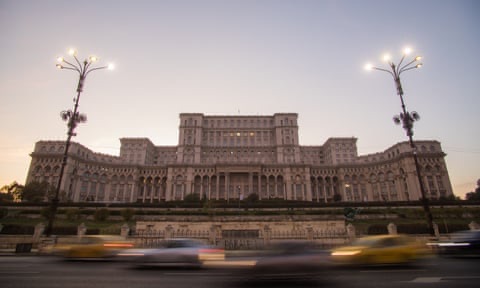
Sometimes the most memorable excursion isn’t on the itinerary.
This morning aboard the Avalon Passion, I walked into the Panorama Lounge expecting to hear a presentation about the Romanian Revolution of 1989. Instead, I spent the next hour listening to one Romanian tell the story of his life.
Our cruise director, Adrian, grew up under Nicolae Ceaușescu’s communist regime. What he shared wasn’t a history lesson from a textbook. It was his childhood, his memories, and the events that forever changed his country.
He began by describing everyday life under communism. Food was rationed. Electricity was rationed. Families carefully saved candles and flashlight batteries so children could read after dark. People stood in long lines, often without knowing what was being sold. If there was a queue, they joined it, hoping whatever was available might be something their family needed.
Adrian even showed us one of the ration coupons used by Romanian families in 1986. Holding that small piece of paper in his hand made history suddenly feel very real.

One story especially stayed with me. Adrian told us that he didn’t like Sibiu salami, a prized food at the time, so he fed it to the neighborhood cats. 🐈⬛ His neighbors reported him to the authorities for wasting rationed food, and the police came to his family’s door. It wasn’t really a story about salami. It was a story about living in a society where neighbors feared one another and ordinary acts could attract the attention of the government.
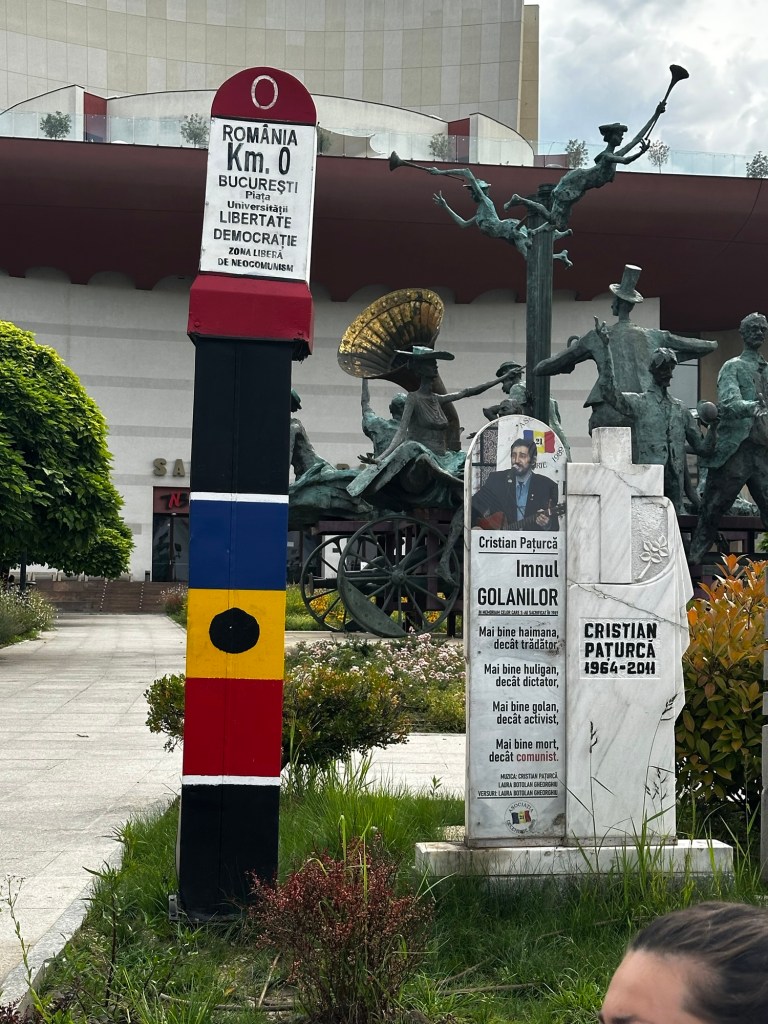
As a child, Adrian was held back in school because the authorities believed he came from a Christian family. He remembered his teacher being devastated because she knew the decision had nothing to do with his ability. She understood that his future had just become more difficult.
When he was fourteen, he began asking questions. Why did products from outside the communist world seem so much better than those available in Bucharest? His first pair of blue jeans cost about the equivalent of an entire month’s minimum wage. To him, they weren’t just jeans. They represented a glimpse of a world beyond Romania’s closed borders.
Adrian also shared an example of how scarcity could create unexpected fortunes. He told us that one of Romania’s wealthiest businessmen today once drove a gasoline truck during the years when fuel was tightly rationed. According to Adrian, corruption, bribery, and the black market became part of everyday life under the communist system. While ordinary citizens struggled to obtain basic necessities, some people were able to use their positions to accumulate wealth and influence. It was one more reminder that shortages often benefited those with access and connections while everyone else waited in line.
Another part of Adrian’s presentation was difficult to hear. He explained that the communist government banned abortion and severely restricted access to contraception in an effort to increase Romania’s population. According to Adrian, the policy resulted in many children being born into families that were unable or unwilling to care for them, while countless others grew up in state-run institutions. He wasn’t discussing politics in the abstract. He was describing the human consequences that he witnessed growing up in Romania and how government policies reached into the most personal parts of people’s lives.
Romania was isolated from the outside world. Ordinary citizens couldn’t simply travel abroad. Passports were tightly controlled because the Communist Party feared people would never return. Adrian described secret police riding buses and trains dressed as ordinary citizens, quietly listening to conversations and watching for signs of dissent. Even in his own home, his father was afraid to turn the radio up too loudly, worried that neighbors might report them if they heard foreign broadcasts or criticism of the government.

Then Adrian took us to December 21, 1989.
He had recently graduated from university and had been assigned a government job as an economist, despite having little idea how to do the work. That evening, he discovered the discotheque was unexpectedly closed. On his way home, he met five friends. One mentioned there was a protest gathering in University Square.
“Let’s go,” Adrian said.
The demonstration grew larger as people chanted that they no longer wanted communism or their leader, Nicolae Ceaușescu. The government first tried to disperse the crowd with water cannons. When that failed, soldiers fired into the crowd. Still, the protesters refused to leave.
Then came the tanks.
Adrian quietly told us that one of his friends, a seventeen-year-old girl, was killed. He said he has lived with the guilt ever since because he was the one who suggested they go to the square that evening.
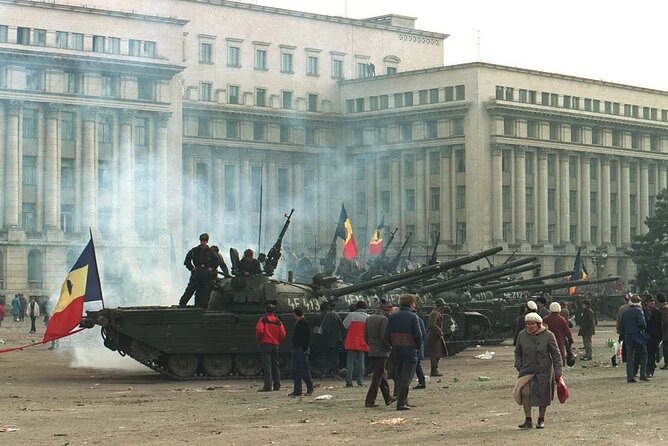
He escaped by hiding in a cellar before making his way home. The next morning, despite everything he had witnessed, he went to work because he was afraid of the consequences of not showing up. His father, although opposed to the regime, urged him to keep his head down. Survival often meant silence.
Later that day, state radio announced that Ceaușescu would address the nation. Adrian felt compelled to return to University Square. He arrived just as the crowd began openly turning against the president. Before long, Ceaușescu fled by helicopter. He was captured days later, and on Christmas Day, he and his wife were executed after a brief trial.
Adrian told us that many Romanians wanted a genuine public trial because they believed that was what a true democracy deserved. He also shared his own view that, despite the fall of the regime, the revolution itself was later “stolen” through politics. He and many others continued protesting for months afterward.
One detail made me smile. Adrian said that as a child he thought bananas and oranges naturally grew in the winter because Christmas was the only time they ever appeared in stores. After the revolution, shops suddenly filled with products most Romanians had rarely or never seen…bananas, oranges, chewing gum, and countless everyday items that had once seemed unimaginable, mainly because the newly formed government wanted to stay in power and won the next election.
Years later, the new government gave citizens the opportunity to read the files that the secret police had kept on them. Many discovered that neighbors, coworkers, and even close friends had informed on them.
Adrian never opened his.
He told us he didn’t want to know if someone he loved had betrayed him.
As he concluded his presentation, he left us with one final thought:
“During communist times, everyone was listening and nobody was talking. Today, everyone is talking and nobody is listening.”
Undeniably, we weren’t listening to a historian. We were listening to a man tell the story of his own life.
As I left the lounge, I realized that this had become one of the most meaningful experiences of my journey through Eastern Europe.
Sometimes the greatest gift of travel isn’t seeing another landmark.
Sometimes it’s listening to someone who lived the history you’ve only ever read about, and the fear that I’m seeing the signs of this happening in my own country. I don’t think there is much difference between communism and authoritarianism. The people in power get everything, leaving nothing or the scraps for the citizens. I wish more Americans could have heard Adrian’s story today.


 Cleared For Take-Off!